Custom Machined Parts for Oil and Energy Equipment Makers
 Carl EricksonLast Updated: Nov 12, 2026
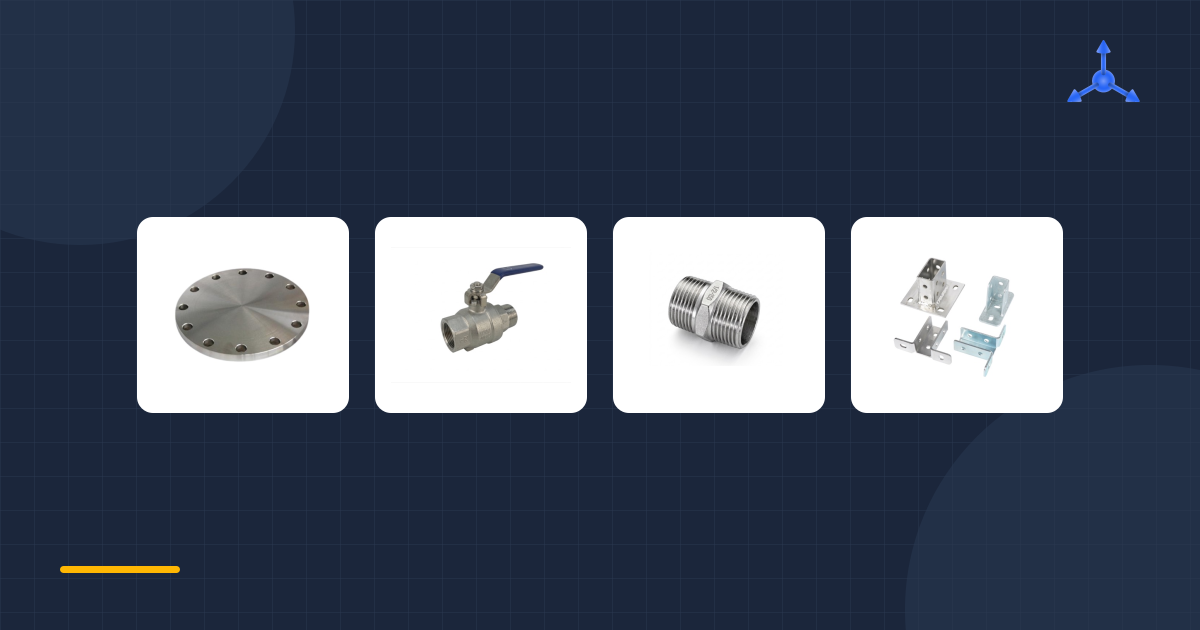
Oil and gas equipment makers buy machined parts, pipe fittings and flanges to a named standard rather than a catalogue equivalent. Vector Components supplies those parts to drawing and specification. We are the authorized representative of several leading Chinese manufacturers of industrial components, supporting buyers in Canada and the United States.
What Each Piece of Oil and Energy Equipment Needs Sourced
Oil and energy equipment is a train of pressure-containing units, and each unit buys in a different set of parts.
Four bodies write the standards behind those parts: the American Society of Mechanical Engineers (ASME), the Manufacturers Standardization Society (MSS), the International Organization for Standardization (ISO) and the American Petroleum Institute (API). Size is written as nominal pipe size (NPS) or nominal diameter (DN).
| Equipment | Parts bought in | Standard | What goes wrong |
|---|---|---|---|
| Chemical injection skid | Small-bore fittings, needle valves | MSS SP-114, ISO 4144 | Thread form swapped |
| Separator or treater | Nozzle flanges, blinds, drains | ASME B16.5 to NPS 24 | Class below vessel rating |
| Production manifold | Header spools, large-bore flanges | ASME B16.47 Series A or B | Series mixed at a joint |
| Pump or compressor | Shafts, housings, impellers | The customer's drawing | Tolerance set left off |
| Metering skid | Flanged spools, isolation valves | Line class, MSS SP-114 | Fitting class under-rated |
| Wellhead or christmas tree | Flanged connections, ring gaskets | API 6A and API 6B | ASME flange substituted |
Every row turns on one thing: the part has a standard, and the standard belongs on the order. Oil and energy is one of four industries we name, with robotics and automation, medical equipment and automotive.
Chemical Injection Skids Run on Small-Bore Fittings
A chemical injection skid meters inhibitor, methanol or biocide into a flowline, and almost all of its hardware is small-bore: tubing, threaded or socket-weld fittings, needle valves and isolation valves.
Two standards cover those fittings. MSS SP-114 sets corrosion-resistant threaded and socket-welding fittings in Class 150 and Class 1000, and ISO 4144 sets stainless steel fittings threaded to ISO 7-1.
Thread form is where skids leak. An ISO 7-1 taper thread and an American National Standard taper pipe thread (NPT) share a nominal size and nothing else. Injection discharge also runs above the suction side, so a Class 150 fitting in a Class 1000 position will eventually fail.
We supply pipe fittings to MSS SP-114 and ISO 4144, or to the customer's own standard. Sirius Instrumentation and Controls, which supports the oil and gas industry with injection systems, automation and control equipment, and solar power generators, places repeat orders with us for pipe fittings and related hardware.
Separators and Treaters Need Flanges Rated to the Vessel
A separator or a treater is a pressure vessel, and its bought-in parts are mostly the flanges on its nozzles: inlet, gas outlet, liquid outlet, relief, manway and drain.
ASME B16.5 covers NPS 1/2 through NPS 24, which carries almost every nozzle on a separator. Class is set by the vessel rather than the pipe: a flange has to hold the vessel's maximum allowable working pressure (MAWP) at design temperature, and allowable pressure falls as temperature rises.
A Class 300 flange is therefore not a thicker Class 150 flange of the same bore. Bolt circle, bolt count and thickness differ.
Facing is the line most often left off a purchase order. A raised face will not seal against a flat face, and a ring-type joint groove needs its own ring. A heat exchanger asks the same question at its nozzles and channel end.
Our flange range runs DN15 to DN2000, to ASME B16.5, ASME B16.47, the Chinese HG 20592 to 20605 and HG 20615 to 20626 series, or the client's own standard. Materials are carbon, alloy and stainless steel, from Class 150 to Class 2500.
Production Manifolds Reach the Large-Bore Flange Range
A production manifold gathers several flowlines into one header, and the header is where the flange standard changes. Above NPS 24, ASME B16.5 stops and ASME B16.47 takes over.
ASME B16.47 comes in two series that are not interchangeable. At the same size and class, Series A and Series B differ in outside diameter, bolt circle, bolt count and bolt size, so one will not bolt to the other.
A drawing citing ASME B16.5 at a 30-inch bore cites the wrong standard, and a quotation citing ASME B16.47 without the series is incomplete.
A header set is also a repeat order, and repeat orders drift when the part moves between plants. A factory that cannot make part of a batch usually subcontracts it and adds a commission. We select the manufacturer suited to each part instead.
Pumps and Compressors Take Parts Made to a Drawing
Pumps and compressors are the equipment here whose replacement parts have no published standard. A shaft, a sleeve, an impeller, a wear ring, a plunger and a cylinder liner are made to the original equipment maker's drawing.
Four processes cover that work: Computer Numerical Control (CNC) lathe, CNC mill, casting and wire electrical discharge machining (EDM). Geometry decides which. A wire EDM cut holds a profile a mill cannot reach, and casting answers when the shape rather than the tolerance is hard.
Materials run to aluminium, steel, stainless steel, zinc alloy, copper alloy and engineering plastics, with grades listed on our CNC machining page.
What goes wrong on a pump part is rarely the size. It is a tolerance left off the drawing, a sealing surface with no finish called out, or a shaft ordered in stainless with no grade.
Metering Skids and Instrument Hookups Fail at the Thread
A metering skid is a short run of pipe with instruments on it, and the parts that fail are rarely the instruments. A meter tube with flanged ends, block and bleed valves, a transmitter manifold and impulse tubing make up most of the hardware.
Flanges on the meter tube follow the line class. The hookup downstream of the tap follows a fitting standard instead, where MSS SP-114 Class 1000 and ISO 4144 both appear.
The meter and the transmitter are not what we supply. The spool, the ball valves, the needle valves, the fittings, the strut channel and the sheet-metal enclosure around them are.
North American wholesalers stock generic versions of most of those items, and a generic fitting is not a defective one. It is made to whatever standard the distributor buys against, which is adequate until an inspector asks which. We batch-manufacture for more specific requirements, at competitive pricing.
Wellheads and Christmas Trees Fall Under API 6A
A wellhead and the christmas tree above it are governed by API 6A, a different regime from the rest of this page. It sets material classes, temperature classes, product specification levels and pressure ratings from 2,000 to 20,000 psi.
API 6B flanges serve ratings up to 5,000 psi and API 6BX the higher ones, with type R, RX and BX ring gaskets. Bore, ring groove and bolting all differ from an ASME flange of the same size.
So an ASME B16.5 flange cannot stand in for an API 6B flange. The sizes read alike on a bill of materials; the parts will not mate.
Our published flange range names ASME B16.5, ASME B16.47 and the HG series, or the client's own standard. It does not name API 6A or 6B, and an API monogram comes from a licensed manufacturer, so settle that before a quotation.
The hardware around the tree is different. Flare and vent line fittings, skid steel, brackets and machined parts to a drawing sit inside what we supply.
What This Supply Route Does Not Cover
Component supply to specification leaves five things to somebody else, all worth settling before a quotation.
We are not a certification body. We issue no pressure-vessel or pipeline code stamp, and hold no manufacturing certificate of our own. Our partner factories hold ISO 9001, International Automotive Task Force (IATF) 16949 and ISO 14001 certificates, covering CNC machining, pipe fittings and flanges, and investment casting.
Code construction stays with a code shop, and system engineering with the buyer's engineer. A separator built to the ASME Boiler and Pressure Vessel Code carries the fabricator's stamp. Line sizing, vessel calculation and relief sizing are not component supply either.
Same-week replacement is not what this route is for. Standard parts typically arrive within two weeks, which makes it planned replenishment rather than a breakdown route.
We do not own or run a factory. Parts are made by the partner factories we represent, each with an agreement authorizing us as its overseas sales department.
Geography narrows it last. We support customers in the Canadian and United States markets, Canada first.
What to Send to Get a Quote on Oil and Energy Equipment Parts
Send computer-aided design (CAD) drawings and specifications, and a quotation comes back within one business day. Quotations are free.
For a standard part, five lines settle most of it.
- The standard, named not described
- Nominal size, in NPS or DN
- Pressure class and design temperature
- Material and grade
- Facing, finish or coating
For a drawing part, send the drawing. Process choice follows geometry and tolerance, so a drawing without a tolerance set returns an estimate.
After the order we coordinate manufacturing, quality control and delivery. We select the best manufacturer for each part and process, talk directly with the engineers in charge, move parts between factories, and supervise inspection, assembly, packaging and shipping.
We invoice on NET 30, and we are legally bound to adhere to North American business standards, which gives a buyer legal recourse that a factory abroad does not.
Vector Components Corp. is at Unit 304, 2999 Underhill Ave., Burnaby, BC V5A 3C2, reachable at contact@vector-components.com or +1 236-869-3830. The parts are made in China; the contract is in British Columbia.
Send us the drawing.
FAQs
Do you supply parts for oil and gas equipment?
Yes. Oil and energy is one of four industries Vector Components names. Sirius Instrumentation and Controls, which supports the oil and gas industry with injection systems, automation and control equipment, and solar power generators, places repeat orders for pipe fittings and related hardware. The work is component supply to specification rather than system design.
Which flange standards can be manufactured?
ASME B16.5, ASME B16.47, the HG 20592 to 20605 and HG 20615 to 20626 series, or the client's own standard. The range runs DN15 to DN2000 in carbon, alloy and stainless steel, from Class 150 to Class 2500. On a separator nozzle, the class follows the vessel's rating at design temperature rather than the pipe.
What standards apply to pipe fittings?
Commonly MSS SP-114 and ISO 4144, or whichever standard the customer specifies. MSS SP-114 covers threaded and socket-welding fittings in Class 150 and Class 1000, and ISO 4144 covers stainless fittings threaded to ISO 7-1, which is not interchangeable with NPT. Name the standard on the order, not just the size.
Why order fittings to specification rather than buying stock?
North American wholesalers stock generic versions, which suit general requirements. A part batch-manufactured to the exact specification matches the standard, the pressure class, the facing and the material grade an injection skid or a meter run was designed around. Standard parts made this way typically arrive within two weeks, at competitive pricing.
Are the factories certified?
The partner factories hold ISO 9001, IATF 16949 and ISO 14001 certificates, covering CNC machining, pipe fittings and flanges, and investment casting. Those certificates belong to the factories that make the parts. Vector Components does not hold them, does not own or run a factory, and issues no pressure-vessel code stamp.
How quickly can you quote?
Within one business day of receiving drawings and specifications, at no cost. For a standard part, give the standard, the nominal size, the pressure class and the material grade. For a machined part on a pump or compressor, send the drawing, because process choice follows geometry and tolerance rather than the description of the part.
Related Reading

Carl Erickson
Founder and Chief Executive, Vector Components
Carl Erickson is a mechanical engineer and the founder and chief executive of Vector Components. He first went to Shenzhen in 2005 and spent more than fifteen years there building electromechanical products, managing factories and developing supplier networks. Vector Components brings nearly two decades of hands-on manufacturing experience in China to its customers in Canada and the United States.
About Carl EricksonRelated Signals