
Socket Weld, Butt Weld or Threaded: Specifying Pipe Fittings
 Carl EricksonLast Updated: Nov 12, 2026
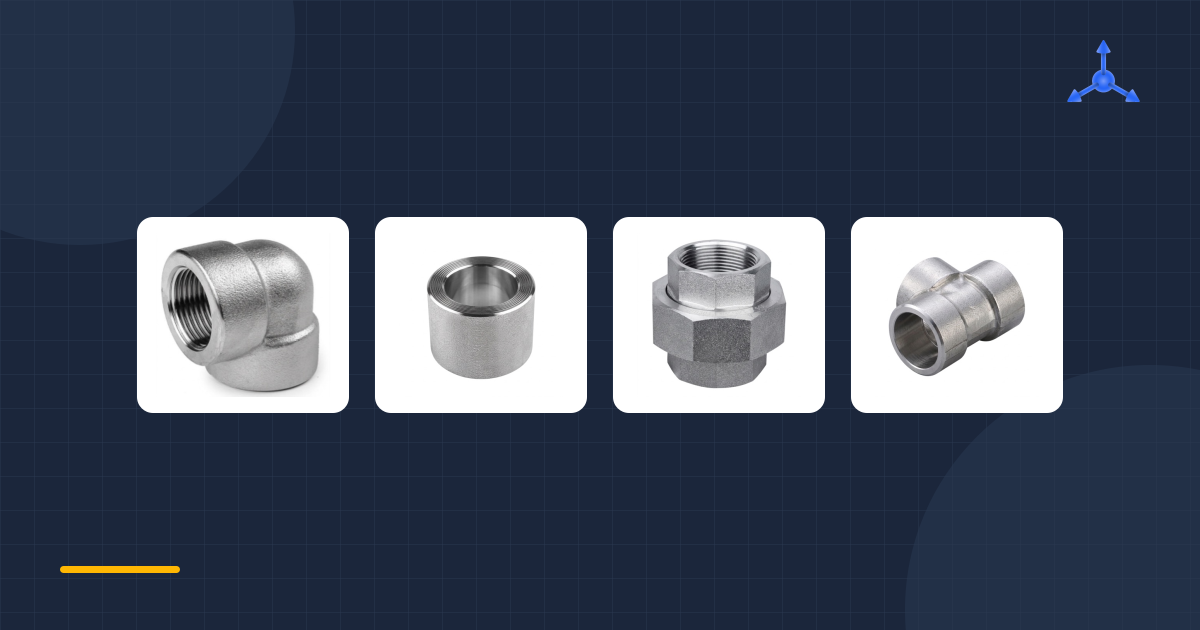
Socket weld, butt weld and threaded ends join a fitting to pipe in three different ways. A butt weld can be radiographed and suits the highest pressures, a socket weld is quicker to fit in tight space, and a threaded end can be dismantled.
Vector Components quotes all three. Pipe fittings are commonly made to MSS SP-114 and ISO 4144, or the customer's choice of standard.
How Does Each End Type Join the Pipe?
Three mechanisms, each with its own consequences downstream.
A socket weld fitting has a machined recess. The pipe slides into it until it bottoms, is backed off slightly, and a fillet weld runs around the outside of the joint. The weld is external and the pipe wall is not penetrated.
A butt weld fitting has a prepared end matching the pipe's own. The two are aligned, root gap set, and welded through the full wall thickness. The joint becomes continuous metal with no step inside.
A threaded fitting has a tapered thread. The pipe screws in, sealed by thread engagement and a sealant or tape, and comes apart again with tools.
The site's own fitting pages follow those three: socket weld, butt weld and threaded, alongside bushings, nipples and plugs.
Which End Type Suits the Pressure and the Service?
Butt weld at the top of the pressure range, for a reason that is about inspection rather than strength.
A full-penetration butt weld can be radiographed through its thickness. A film or a digital detector on the far side shows porosity, lack of fusion and inclusions through the whole joint. That is why high-pressure and high-consequence specifications call for it: not because the metal is stronger, but because the weld can be proved.
A socket weld's fillet cannot be radiographed the same way. It is inspected by surface methods, which are real but narrower in what they can see.
A socket weld also leaves an internal crevice: a small annular gap between the pipe end and the bottom of the socket. In most services that is harmless. In a service where the medium can sit in it and concentrate, or where the line has to be fully drainable, it matters.
Threaded ends are the practical choice where a line must come apart. Instrument connections, sample points and anything needing periodic removal are far easier threaded. The trade-off is that the joint relies on the thread and the sealant rather than continuous metal, so pressure and vibration limits are tighter.
Which Standards Do the Fittings Follow?
Commonly MSS SP-114 and ISO 4144, or the customer's choice of standard.
MSS SP-114 is a Manufacturers Standardization Society (MSS) standard practice covering corrosion-resistant pipe fittings. ISO 4144 is the International Organization for Standardization (ISO) standard for threaded pipe fittings in stainless steel.
Naming the standard on the drawing matters more than it appears. Two fittings of the same nominal size to different standards can differ in wall thickness and in the length the pipe engages, and the second of those decides whether a socket weld joint has the engagement its design assumed.
The customer's own standard is also quoted. As with flanges, a company standard usually departs from the published one in a few specific dimensions rather than throughout.
What Has to Be on a Fitting Drawing?
End type, nominal size, pipe schedule, standard, material grade and quantity.
Schedule is the field most often left off, and leaving it off is the most common source of a fitting that does not match the line. Nominal size fixes the outside diameter. Only the schedule fixes the wall thickness, and therefore the bore the fitting has to match.
A fitting ordered to the right nominal size and the wrong schedule looks correct and does not fit the pipe it was bought for.
Sirius Instrumentation and Controls places repeat orders for pipe fittings and related hardware. It supports the oil and gas industry with injection systems, automation and control solutions and solar power generators, which is a service where end type and schedule are specified rather than assumed.
North American wholesalers stock generic versions of common fittings, and those suit many jobs. Vector batch-manufactures for customers with more specific requirements, which is where a non-stock schedule, material or end combination comes from.
Which Should You Order?
Decide on three things in order: the pressure and inspection requirement, whether the line has to come apart, and the space available.
Pressure and inspection first. If the specification requires radiography, butt weld. If it does not, socket weld is lighter work and faster to fit.
Dismantling second. If the joint has to be broken for maintenance or calibration, threaded, and accept the pressure limit that comes with it.
Space third. A butt weld needs access all around the joint for the welder and for the inspection. In a congested rack a socket weld is often the only one that can physically be made.
Then keep it consistent. A line list with three end types scattered through it is a line list that will be assembled wrongly somewhere.
Standard parts made to exact specification typically ship within two weeks. Send computer-aided design (CAD) drawings and specifications, or the line list; a quotation follows within one business day, quotations are free, and payment terms are NET 30.
Parts are made by the partner factories Vector represents.
Send the line list.
FAQs
What is the difference between a socket weld and a butt weld fitting?
A socket weld fitting has a recess that the pipe slides into, welded with a fillet around the outside. A butt weld fitting joins two prepared ends in line, welded through the full wall. The butt weld can be radiographed through its thickness, which is why high-pressure specifications usually call for it.
Which pipe fitting end suits high pressure?
Butt weld, in most specifications, because the joint is a full-penetration weld that can be inspected radiographically through the wall. Socket welds and threaded ends are both used at pressure, but the inspection options are narrower, which is usually what the specification is really selecting for.
Why would anyone choose a threaded fitting?
Because the line has to come apart. Instrument connections, sample points and anything that needs periodic removal are far easier threaded than welded. The trade-off is that a threaded joint relies on the thread and the sealant rather than on continuous metal, so pressure and vibration limits are tighter.
What standard are your pipe fittings made to?
Commonly MSS SP-114 and ISO 4144, or the customer's own choice of standard. Stating the standard on the drawing matters more than it appears, because two fittings of the same nominal size to different standards can differ in wall thickness and in the length the pipe engages.
What does a pipe fitting drawing need to state?
End type, nominal size, pipe schedule, the standard, the material grade and the quantity. Schedule is the field most often left off: nominal size fixes the outside diameter, and only the schedule fixes the wall thickness and therefore the bore the fitting has to match.
Can fittings be made to our own standard?
Yes. Alongside MSS SP-114 and ISO 4144, fittings are quoted to the customer's choice of standard. Send the standard document or reference it on the drawing, because company standards usually depart from the published one in a few specific dimensions rather than throughout.
Related Reading

Carl Erickson
Founder and Chief Executive, Vector Components
Carl Erickson is a mechanical engineer and the founder and chief executive of Vector Components. He first went to Shenzhen in 2005 and spent more than fifteen years there building electromechanical products, managing factories and developing supplier networks. Vector Components brings nearly two decades of hands-on manufacturing experience in China to its customers in Canada and the United States.
About Carl EricksonRelated Signals