Strut Channel to Spec: 7 Things to Settle Before Ordering a Custom Length and Finish
 Carl EricksonLast Updated: Nov 12, 2026
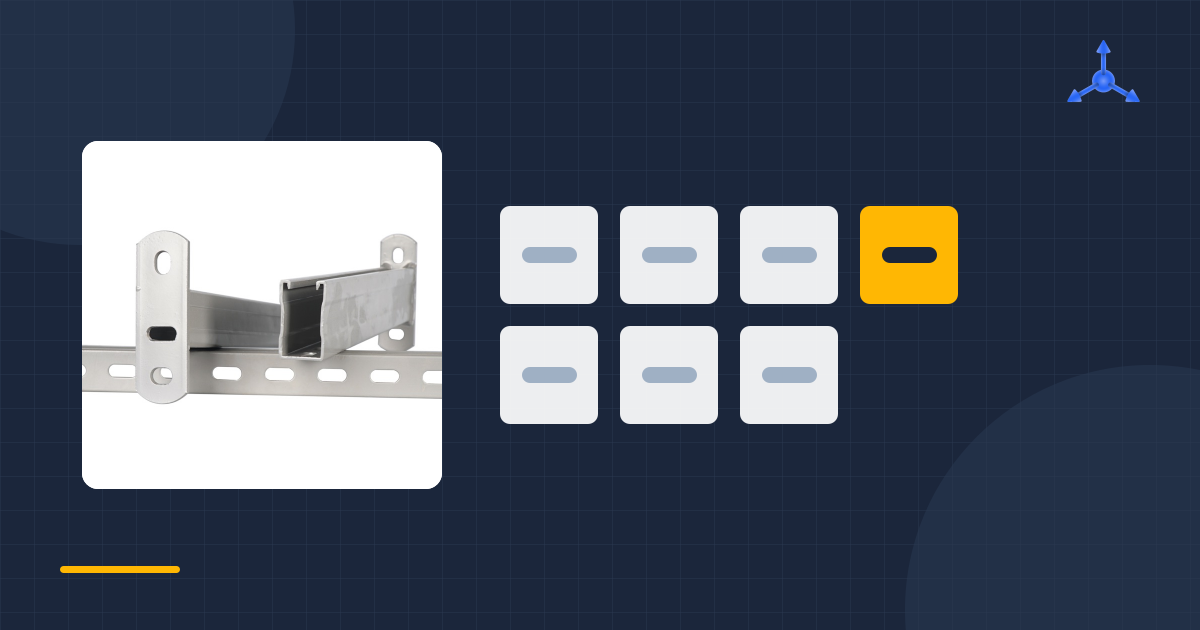
Strut channel is made to a custom length and finish routinely, and seven items decide whether the order arrives usable: gauge, section depth, slot pattern, finish, length, hole spacing and the load the run has to carry. North American wholesalers stock a generic version. A part made to specification costs more to set up and less to install.
The seven sit in the order they matter on the drawing. Gauge and depth decide what the run holds; the rest decide whether it goes up cleanly.
- Gauge, the thickness of the steel before forming.
- Section depth, with the face width that goes with it.
- Slot pattern: slot length, slot width, pitch and lip return.
- Finish: pre-galvanised, hot-dip galvanised or stainless steel.
- Length, cut at the factory rather than on site.
- Hole spacing, with the datum end named.
- The load the run has to carry, with the span.
What Do Gauge and Section Depth Decide?
Gauge and section depth decide what a strut channel run carries over a given span. Gauge is the thickness of the steel before forming. Section depth is how far the formed section stands off the surface it is bolted to.
The mechanism is section modulus, which describes how the steel is distributed about the bending axis. Depth raises it faster than thickness does, because adding depth moves material further from that axis. Thickness still earns its place, governing what happens locally at a slot edge and at the thread engagement under a channel nut.
The two are not interchangeable. A deeper section in a lighter gauge and a shallower one in a heavier gauge can land close on bending strength and behave differently at the fixing. One deflects less over the span; the other holds a point load at the nut better.
Deflection usually governs a long run before yield does. A run strong enough to hold the weight can still move more than the equipment hanging from it tolerates, which is a decision for the engineer of record.
No load table appears on this page, deliberately. A span figure is worth having only when it comes from the test data of the factory that rolls the steel, with the load case, the support condition and the deflection limit beside it. Strut channel is one of the products we supply, and the parts are made by the partner factories we represent, so that data is theirs to issue.
Ask for it with the quotation, against the gauge and depth being quoted. A run priced without that data may be perfectly sound, but nothing on paper says so.
Why Is the Slot Pattern Not Universal?
The slot pattern is not universal because slot length, pitch and face width differ between makers, and those dimensions decide which channel nuts and fittings engage. A channel nut turns into the slot and seats against the returned lips of the formed section. The lip return and the opening have to suit the nut, or it will not seat.
Pitch is the repeat distance along the length, and it decides where a fixing can land. A coarse pitch pushes the hanger to the nearest slot rather than the position on the drawing. Face width decides which brackets, fittings and splice plates sit flat.
A hardware mismatch surfaces at installation, which is the worst place to find it. Fittings bought for one run do not engage the other, the crew is already on site, and the parts that do not fit are the cheapest items on the order.
So dimension the pattern rather than describe it. A drawing of the face, dimensioned at the slot and at the lip return, settles what gets made, and a physical sample settles it faster still. We quote customer-designed parts from drawings and specifications, and standard parts batch-made to exact specification.
We will not tell you that a section is interchangeable with another maker's pattern. Interchangeability is a dimensional claim about somebody else's product, and the only answer we can stand behind is the drawing of the face you want. Hold one pattern across a project and the hardware question goes away.
Which Finish Suits the Environment?
Finish follows exposure. Pre-galvanised strut channel suits dry indoor runs, hot-dip galvanised suits weather and wash-down, and stainless steel suits environments that attack a zinc coating.
Pre-galvanised means the strip is coated before it is formed and punched. The coating is thin and even, and the punched edges and the cut ends come out bare. Zinc protects a bare edge sacrificially over a short distance, which is enough indoors and not outside.
Hot-dip galvanised means the formed section is dipped after fabrication, so the coating covers the slot edges, the cut ends and any weld. The coat is thicker and rougher, and applying it is a separate process step at a separate plant. That step usually moves the lead time, and we coordinate the transfer between factories and supervise the inspection and packaging.
Stainless steel is a material change rather than a coating, so it moves the price structure and the fabrication with it. There is no coating to breach at a cut, because the alloy works through the thickness. Grade is then the decision that matters: 304 handles many indoor applications, and 316L is usually the better choice near salt water.
Side by side, the three differ on where the coating sits and what happens at a cut.
| Finish | Coating applied | Cut ends | Suits |
|---|---|---|---|
| Pre-galvanised | Before forming | Left bare | Dry indoor runs |
| Hot-dip galvanised | After fabrication | Fully coated | Weather and wash-down |
| Stainless steel | None, alloy throughout | No coating to breach | Salt and chemical exposure |
Cut-to-length matters more outdoors than indoors, for one reason. A site cut opens bare steel at the end of the run, and the best repair on site is a zinc-rich paint. Cut at the factory and the cut happens before the dip, so the end is coated like the rest.
When Is Made-to-Spec Cheaper Than Stock?
Made-to-spec strut channel beats stock when the generic section does not match the requirement, or when volume covers the setup. North American wholesalers stock generic versions, and we batch-manufacture for customers with more specific requirements.
Setup cost is fixed rather than charged by the metre. Roll tooling is set for the section, punch tooling is set for the slot pattern, and a galvanising batch is scheduled. Spread that fixed cost across a short order and it dominates the price; spread it across a production run and it disappears into it.
The crossover is therefore a volume question, not a price question. It depends on volume more than anything else. Below the crossover, stock is simpler and quicker; above it, a part made to the specification installs without being adapted.
The cost missing from the stock comparison is adaptation. Site cutting, drilling, packers and extra fittings all carry labour, and each cut edge opens a corrosion question of its own. Our pricing on batch work is competitive, and the comparison worth making is total installed cost, not price per piece.
If the generic section is what the drawing calls for, the quotation should say so. We do three kinds of work: customer-designed parts, standard parts batch-made to exact specification, and off-the-shelf parts sourced as a courtesy. Strut channel made to a stated gauge, pattern and finish is the middle one.
For items outside the network, our native Chinese staff track down the original source and negotiate the price as a courtesy. That is a different service from tooling up a run, and it is the right one below the crossover.
What Should Be on the Order?
A strut channel order needs seven items stated on it: gauge, section depth, slot pattern, finish, length, hole spacing and the load the run has to carry. Each is a dimension or a named finish on the drawing, not a description in an email.
Item by item, that reads:
- Gauge — the steel thickness the design calls for.
- Section depth — the formed depth, with the face width.
- Slot pattern — slot length, slot width, pitch, lip return.
- Finish — the coating or the alloy, with the grade.
- Length — the cut length per piece, with the tolerance.
- Hole spacing — hole size, spacing and the datum end.
- Load — the load case and the span to check it against.
Send computer-aided design (CAD) drawings and specifications, and a quotation follows within one business day, at no cost. Standard parts made to exact specification typically ship within two weeks. Finish is what usually moves that, since the galvanising step runs to its own schedule.
We are the authorized representative of several leading Chinese manufacturers of industrial components, working from Burnaby, British Columbia, for buyers in Canada and the United States. Each factory in the network has an agreement authorizing us to serve as its overseas sales department. We do not own or run a factory, and the parts are made by the partner factories we represent.
For each part and process we select the manufacturer, talk directly with the engineers in charge in their own language, and supervise inspection, assembly, packaging and shipping. We invoice on NET 30 terms and are legally bound to North American business standards, which gives a buyer recourse that a factory abroad does not.
Send us the drawing. A dimensioned face, a gauge, a finish and a length are enough to quote from.
FAQs
Can strut channel be made to a custom length?
Yes. Cut-to-length is an ordinary batch-manufacturing request, and cutting at the factory removes the site cut along with the bare edge it leaves. Length is stated on the order beside the gauge, section depth, slot pattern and finish. Lead time moves with volume and finish rather than with the cut itself.
What finishes are available?
Strut channel is supplied in three finishes, and each one suits a different exposure. Pre-galvanised is coated before forming and suits dry indoor runs. Hot-dip galvanised is dipped after fabrication, so the cut ends and slot edges are covered, which suits weather and wash-down. Stainless steel is a material change rather than a coating, and it changes the price structure.
Is strut channel from different suppliers interchangeable?
Not reliably. Slot length, pitch and face width decide which channel nuts and fittings engage, and those dimensions differ between makers. Mixing patterns across one site creates a hardware problem that only appears at installation, when the crew and the parts are already there. Specify the pattern on the order and keep it consistent across the project.
When does ordering to specification beat buying stock?
When the generic section does not match the requirement, or when volume covers the setup. Setup cost is fixed rather than charged per piece, so the crossover is a volume question. Below it, a stocked section is simpler and quicker. Above it, a section made to specification installs without being cut, drilled or packed out on site.
What do you need to quote strut channel?
Gauge, section depth, slot pattern, finish, length, hole spacing and the load the run has to carry. A dimensioned drawing of the face beats a description, and a sample beats a drawing. Send computer-aided design drawings and specifications, and a quotation follows within one business day, at no cost.
How long does a custom strut channel order take?
Standard parts made to exact specification typically ship within two weeks. Finish is usually what moves that, because hot-dip galvanising is a separate process step at a separate plant with its own schedule. Volume and the current load at the partner factory decide the rest, which is why the quotation carries the lead time.
Related Reading

Carl Erickson
Founder and Chief Executive, Vector Components
Carl Erickson is a mechanical engineer and the founder and chief executive of Vector Components. He first went to Shenzhen in 2005 and spent more than fifteen years there building electromechanical products, managing factories and developing supplier networks. Vector Components brings nearly two decades of hands-on manufacturing experience in China to its customers in Canada and the United States.
About Carl EricksonRelated Signals