Die Casting vs Investment Casting for Custom Industrial Parts
 Carl EricksonLast Updated: Nov 12, 2026
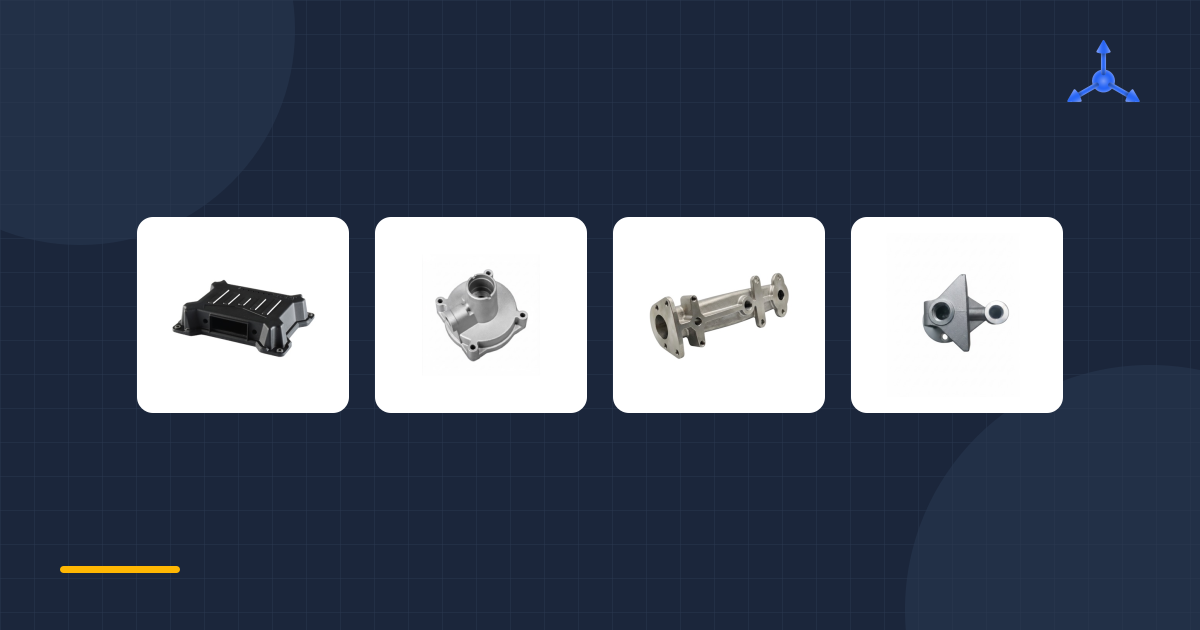
Die casting suits high volumes of aluminium or zinc parts with thin walls and tight repeatability, paid for with expensive steel tooling. Investment casting suits complex geometry and a far wider alloy range, including stainless steel, with cheaper tooling and a higher cost per part. Volume and alloy decide it.
Quick verdict. Two conditions settle most jobs, and one question is worth asking either way.
- Choose die casting when volume is high, the alloy is aluminium or zinc, and the part has thin walls.
- Choose investment casting when the geometry is complex, the alloy is steel or stainless, or volume is moderate.
- Either way, ask who does the machining after the casting. That answer changes the delivered cost more than the process choice.
How Does Each Process Actually Form the Part?
Die casting and investment casting differ at the mould, and every other difference between them follows from that.
Die casting forces molten metal into a reusable steel die under pressure. The die is machined in two halves, clamped shut, and filled through a shot sleeve in a fraction of a second. Pressure drives metal into sections gravity would not fill, and the hardened steel holds its dimensions across a long production run.
The pressure that fills a thin wall is also what constrains the metal. A steel die has to survive thousands of thermal cycles, so the alloy poured into it has to melt well below the die's own working temperature.
Investment casting starts with wax instead of steel. A wax pattern of the part is injected in a soft tool, then dipped in ceramic slurry and stuccoed with refractory grain until a shell builds up around it. The shell is fired, the wax runs out, metal is poured into the cavity the wax left behind, and the shell is broken away to free the casting.
Because the shell forms around the pattern rather than being cut into steel, undercuts, blended radii and cored internal passages reproduce without a parting line driven through them. The shell is also destroyed with every part, so each casting carries its own mould.
Lost wax casting is the same process under an older name. Supplier catalogues use both terms for identical work, and a quotation for lost wax casting is a quotation for investment casting.
The rest of the sequence is shared. Metal solidifies, gates and risers are cut away, and the part is trimmed, shot-blasted and inspected before any machining begins.
The two processes line up like this across the attributes that decide a casting job.
| Attribute | Die casting | Investment casting |
|---|---|---|
| Mould | Reusable steel die | One-use ceramic shell |
| Tooling cost | High | Moderate |
| Cost per part at volume | Low | Higher |
| Typical alloys | Aluminium, zinc, magnesium | Steel, stainless, aluminium, bronze |
| Wall thickness | Thin achievable | Moderate |
| Geometric complexity | Moderate | High |
| Surface finish | Good as cast | Very good as cast |
| Draft angle required | Yes | Minimal |
| Economic volume | High | Low to moderate |
| Tooling lead time | Longer | Shorter |
When Should You Choose Die Casting?
Choose die casting when annual volume is high, the alloy is aluminium, zinc or magnesium, and the part has thin walls that have to come out identical every time.
The steel die is the commercial question. It is a hardened, water-cooled machined tool, quoted as tooling before a single part is made.
Spread across a long production run, the tooling cost per part becomes small. Spread across a short one, it dominates the quote. The first decision is therefore arithmetic rather than engineering.
A housing ordered in thousands a year amortises its die. The same housing ordered in dozens does not, and the tooling line is most of what the buyer pays.
Die casting also earns its place on wall section. Pressure rather than gravity fills the cavity, so thin, consistent walls come out sound. For enclosures and heat sinks, where weight and wall thickness are design constraints, that is usually the deciding factor.
The die itself can shift the arithmetic again. One tool can hold several cavities, so the cost of the tool is divided by the parts it yields per shot as well as by the length of the run.
Two limits are worth stating plainly. Draft angle is required on every face that has to leave the die, so a part drawn without draft needs either a redesign or machining afterwards.
The alloy range is the second limit. Zinc, aluminium and magnesium melt low enough to live with a steel die; carbon steel and stainless steel do not, which rules die casting out of a large share of industrial parts.
Porosity is the characteristic defect. Air and die lubricant trapped during a high-speed fill leave internal voids, which matter on a pressure-tight part and matter very little on a bracket. Where a casting has to hold pressure, the answer is a vacuum-assisted fill, impregnation, or a wall section designed to solidify from the outside in.
Flash along the parting line is trimmed after every shot, and the parting line stays visible on the finished part.
Vector Components lists die casting and investment casting among its products and services.
When Should You Choose Investment Casting?
Choose investment casting when the geometry is complex, the alloy is carbon steel, stainless steel or bronze, or the programme volume will not pay for a steel die.
The ceramic shell is the reason the alloy range opens up. A fired shell tolerates pouring temperatures a steel die could not survive, so carbon steel, stainless steel, tool steel, bronze and nickel alloys are all routine. When a drawing calls for 316L stainless steel, the process question is already settled.
Geometry is the second reason. The shell is broken away rather than opened, so draft angle is close to optional, and cored passages, undercuts and thin webs reproduce from the wax. As-cast surface finish is better than a die-cast surface, which cuts the finishing work ahead of machining.
Tooling is cheaper because the wax tool never has to contain pressurised metal. It is smaller and softer than a pressure die, and it can be modified far more readily once the first castings come back.
Wax patterns are also assembled in bulk. Several patterns are attached to a common sprue so that one shell and one pour yield a tree of parts, which is how the process stays economical on small components.
The limits of the shell are worth knowing before a drawing is quoted. A shell cracks if it is built too thin or fired too fast, and a larger, heavier casting needs a heavier shell built more slowly, which lengthens the cycle rather than the tooling bill.
The trade sits in the unit price. Every part consumes a shell, and the labour of building, firing and breaking that shell is in every unit.
Cost per part therefore stays close to flat as quantity rises. That is the honest limit of investment casting, and it is what reverses the answer at volume.
Below the crossover quantity, tooling plus parts totals less with investment casting. Above it, the amortised die wins on cost per part. A programme that grows from hundreds to tens of thousands a year usually re-tools into die casting rather than scaling the shell line.
Who Does the Machining After the Casting?
Machining after the casting decides delivered cost more often than the choice between the two casting processes does.
As-cast surfaces serve many features and not the critical ones. Sealing faces, bearing bores, threads and datum surfaces get machined. The real question on a quotation is who holds that work: the foundry, a second shop, or the buyer's own machinists.
A foundry that cannot make a part usually subcontracts it and adds a commission, which raises the price and brings quality and logistics problems with it. The buyer pays that commission without ever seeing it broken out.
A casting that crosses a company boundary for machining also collects a second set of fixtures, a second inspection report and a transport leg. Each of those is priced, and none of them appears on the casting quotation.
Agreeing the machining supplier at quotation time is what makes a comparison honest. Two casting quotes are only comparable when both carry the same scope through to a finished part.
Vector Components is the authorized representative of several leading Chinese manufacturers of industrial components, supporting customers in the Canadian and United States markets. Each factory in the network has an agreement authorizing Vector to serve as its overseas sales department.
Vector selects the manufacturer best suited to each part and process, talks directly with the engineers in charge, coordinates the transfer of parts between factories, and supervises inspection, assembly, packaging and shipping. The parts are made by the partner factories Vector represents. Vector does not own or run a factory.
For customer-designed parts the main processes are Computer Numerical Control (CNC) lathe, CNC mill, casting and wire Electrical Discharge Machining (EDM). Vector's team works with the production engineers in their native language, which matters because Chinese engineers rarely speak English and factory sales staff rarely have technical training.
Vector's partner factories hold International Organization for Standardization (ISO) 9001, International Automotive Task Force (IATF) 16949 and ISO 14001 certificates, covering CNC machining, pipe fittings and flanges, and investment casting.
Which Process Fits Your Volume and Alloy?
Work the decision in one order: alloy first, then geometry, then volume.
Alloy comes first because it eliminates. A carbon steel or stainless steel part is an investment casting, and the remaining question is who machines and inspects it. An aluminium or zinc part keeps both processes open.
Geometry comes second. Faces that cannot carry draft, cored internal passages and undercuts point to the ceramic shell. A part that opens cleanly across one parting line keeps die casting available.
Volume comes last, because it only chooses between the options the first two questions left standing. Where both processes can make the part, the quantity over the life of the programme decides which tooling is worth buying.
Suppose a bracket is drawn in 316L stainless steel at a few hundred pieces a year. Alloy rules out die casting at the first question, so what remains to settle is the shell, the machining and the inspection, not the process.
Change the same bracket to aluminium at tens of thousands a year and the order of questions gives the opposite answer. Both processes can make it, the geometry does not force a shell, and the volume pays for a die.
Sand casting is available through the partner factories, though it is not typical for the scale of Vector's projects, and the published service list covers die casting and investment casting.
What belongs on the drawing is the same either way. Alloy and grade, the dimensions that are critical and the ones that are not, the surface finish required, and which faces will be machined after the casting.
Those four things are what a quotation is built from. A drawing missing any of them produces a price that will move once the detail arrives.
A quotation settles all three questions faster than analysis does. The alloy is on the drawing, the geometry is on the drawing, and the quantity is a number the buyer already knows.
Send Computer-Aided Design (CAD) drawings and specifications, and a quotation comes back within one business day. Quotes are free.
Send us the drawing.
FAQs
What is the main difference between die casting and investment casting?
The mould. Die casting forces metal under pressure into a reusable steel die; investment casting builds a one-use ceramic shell around a wax pattern and pours. That single difference drives everything else: tooling cost, alloy range, achievable geometry, and the volume at which each process becomes economic.
Which process handles stainless steel?
Investment casting. The ceramic shell tolerates the pouring temperatures steel and stainless steel require, which is why the process is standard for stainless parts, while die casting works in aluminium, zinc and magnesium, whose melting points suit a steel die. Aluminum die casting and zinc die casting are the common cases, and alloy usually settles the process choice first.
Is lost wax casting the same as investment casting?
Yes. Lost wax casting is the older name for the same process: a wax pattern is coated in ceramic, the wax is melted out, and metal is poured into the cavity left behind. Both terms appear in supplier catalogues, and both describe identical work.
Which is cheaper, die casting or investment casting?
It depends on volume more than anything else. Die casting carries high tooling cost and low cost per part, so it wins at volume. Investment casting carries moderate tooling and a higher cost per part, so it wins below the crossover quantity, which moves with part size and alloy.
Does a cast part still need machining?
Usually, on critical faces and threaded features, though the more useful question is who does that machining. A foundry that cannot machine subcontracts the work and adds a commission, which the buyer pays without seeing it on the quotation. Agreeing the machining supplier at quotation keeps that cost visible.
Is sand casting an option?
Sand casting is available through Vector's partner factories, though it is not typical for the scale of Vector's projects. The process suits large, lower-tolerance parts in moderate quantities. Where a part needs a better as-cast surface finish or tighter repeatability, investment casting or die casting is the usual choice.
Related Reading

Carl Erickson
Founder and Chief Executive, Vector Components
Carl Erickson is a mechanical engineer and the founder and chief executive of Vector Components. He first went to Shenzhen in 2005 and spent more than fifteen years there building electromechanical products, managing factories and developing supplier networks. Vector Components brings nearly two decades of hands-on manufacturing experience in China to its customers in Canada and the United States.
About Carl EricksonRelated Signals