Domestic Machine Shop vs Overseas CNC Supplier for Custom Parts
 Carl EricksonLast Updated: Nov 12, 2026
A domestic machine shop wins on lead time, iteration speed and the ability to walk in. An overseas Computer Numerical Control (CNC) supplier wins on unit cost at volume and on access to processes a small shop does not hold. The decision turns on whether the specification is settled and how many parts follow the first one.
Quick verdict. Two conditions settle most of these jobs, and one question decides the rest.
- Choose a domestic machine shop while the design is still moving, or when the part is needed in days.
- Choose an overseas CNC supplier when the specification is settled and volume justifies the freight and the setup.
- The hidden variable is who controls the tolerance conversation. That is a communication question, not a geography question.
What Does a Domestic Machine Shop Do Better?
A domestic machine shop does better whenever the drawing is still changing, because it shortens the distance between a revision and a part in your hand. Iteration, not machining, is what it is actually selling.
A moving design generates revisions, and every revision is a cycle. Locally that cycle is a phone call, a re-run and a part the same week. Across an ocean it is a re-quote, a production slot and a transit leg.
The cost of being wrong is therefore the variable that matters. While a feature is unsettled, the cheapest supplier is the one that lets you be wrong quickly.
Standing at the machine is the second thing a local shop sells. A machinist can point at a feature and ask whether a tolerance is functional or inherited, which is Design for Manufacturability (DFM) feedback delivered before the first cut.
That conversation changes drawings. A bore held tighter than the bearing needs, or a finish called out on a face nobody touches, is cheaper to find in person than in a first article report.
First article inspection happens on site, which collapses the argument about whose measurement is right. The part, the drawing and the machine that cut it are in one building.
Urgency is the other clear case. A line-down part, a fixture needed for a build next week, a single replacement for an obsolete assembly: none of those wait for freight.
For a design that is still moving, nothing bought overseas competes on iteration. That is not a close comparison, and it is the reason the overseas question is worth asking only once the drawing stops changing.
A domestic machine shop and an overseas CNC supplier line up like this across the attributes that decide a custom part.
| Attribute | Domestic machine shop | Overseas CNC supplier |
|---|---|---|
| Typical lead time | Days to weeks | Weeks |
| Unit cost at volume | Higher | Lower |
| Iteration speed | Fast | Slower |
| Freight cost | Minimal | Material |
| Process breadth | Shop dependent | Broad across factories |
| Tolerance conversation | Direct | Through a representative |
| First article inspection | On site | Pre-shipment |
| Recourse | Local jurisdiction | Depends on contracting party |
| Payment terms | Negotiated | Free On Board, or NET 30 |
| Best for | Prototypes, urgent work | Settled production parts |
Where Does an Overseas Supplier Win?
An overseas CNC supplier wins once the specification has stopped moving and the quantity is large enough to spread the setup across it. It also wins on breadth, for a separate reason.
Setup is paid per part number, not per part. Programming, fixturing, work holding and first article qualification are a fixed charge against the whole run, so the quantity that follows the first part decides how much of that charge each part carries.
At one piece, the setup is the job. At a production quantity it becomes a line item that keeps shrinking, which is why the unit cost ordering reverses somewhere between a prototype and a production release.
Breadth is a structural argument rather than an arithmetic one. A single shop quotes the equipment it owns, so a part needing turning, milling, a casting and a wire-cut feature either moves between vendors or gets redesigned to suit one machine list.
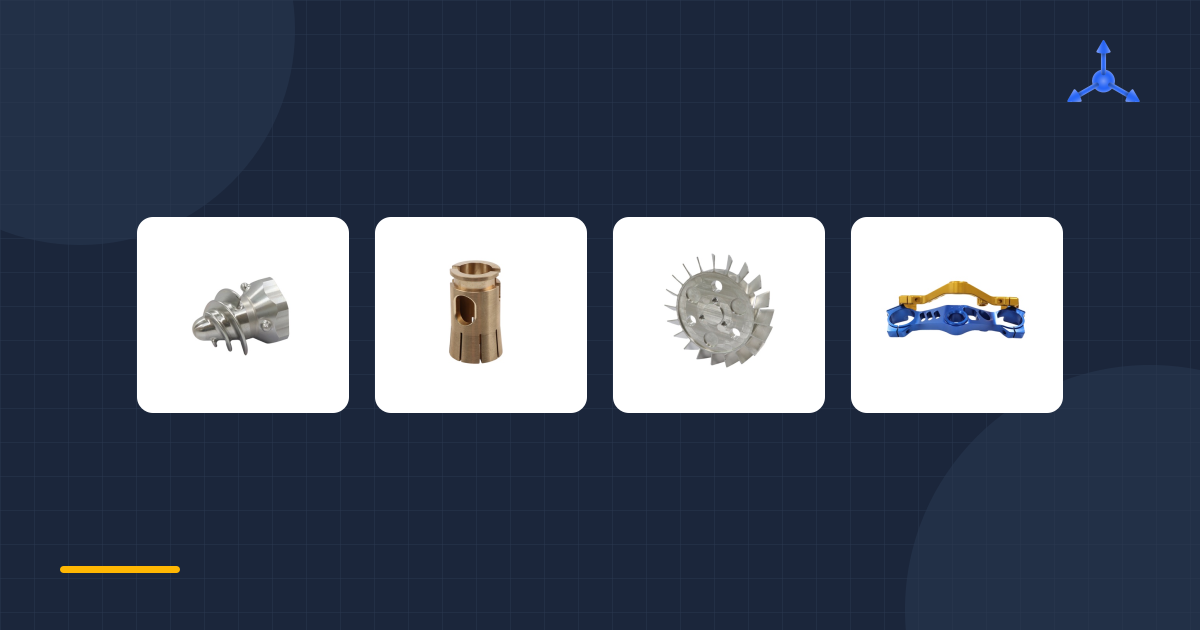
Vector Components works across a network of partner factories instead. For customer-designed parts the main processes are CNC lathe, CNC mill, casting and wire Electrical Discharge Machining (EDM), in aluminium, steel, stainless steel, zinc alloy, copper alloy and engineering plastics.
The commission problem is what breadth is actually solving. A factory that cannot make a part usually subcontracts it and adds a commission, which raises the price and brings quality and logistics problems with it.
Vector selects the manufacturer best suited to each part and process, and coordinates the transfer of parts between factories where a job needs more than one. Each factory in the network has an agreement authorizing Vector to serve as its overseas sales department.
The parts are made by those partner factories. Vector does not own or run a factory, which is the honest shape of the arrangement and the reason factory selection matters as much as the quotation.
Standard parts are the quieter case. North American wholesalers stock generic versions, and a buyer whose requirement is more specific can have the part batch-manufactured to that exact specification, typically within two weeks.
None of this helps at a quantity of one. Freight, setup and the inspection cycle cost much the same whether the order is a single part or a batch, which is what rules the overseas route out of a one-off.
Who Controls the Tolerance Conversation?
The tolerance conversation is controlled by whoever reads the drawing first. On an overseas order that is usually a salesperson, and that one fact explains most of what goes wrong.
Chinese engineers rarely speak English, and factory sales staff rarely have technical training. The drawing therefore reaches production through someone who cannot interrogate it.
An interrogated drawing is a different document. Which dimension is critical, which tolerance is inherited from an earlier revision, which surface mates and which is cosmetic: those answers change the process plan.
What arrives instead is a quotation against the drawing as written. The factory builds what is specified rather than what was meant, and the gap between the two surfaces at first article inspection.
Vector's team works with the production engineers in their native language, and talks directly with the engineers in charge of the part. That takes the sales layer out of the technical conversation rather than adding one to it.
Naming the standard is the other half of controlling the conversation. Pipe fittings are commonly made to Manufacturers Standardization Society (MSS) SP-114 and International Organization for Standardization (ISO) 4144, or to the customer's own choice of standard.
A standard is a shared vocabulary, so a drawing that cites one removes a whole class of interpretation. A drawing that describes a shape in prose invites that interpretation back.
Knowing which plant is on the other end is part of the same problem. Chinese factories often trade under several names, so two quotations can arrive from what look like two suppliers and be answered by one plant.
Buying through an authorized representative means the buyer knows who makes the part. The engineer answering a tolerance question and the plant cutting the metal sit inside the same organization.
The failure is not distance. It is a drawing read by someone who cannot ask the next question, and it happens at any distance where that is true.
What Happens When a Part Fails Inspection?
A part that fails inspection at the factory costs time. The same part failing after it ships costs the freight, the schedule, and usually the production slot behind it.
Pre-shipment inspection is the last cheap point in the chain. It is the last moment at which a reject is a conversation rather than a loss.
Vector supervises inspection, assembly, packaging and shipping on the orders it places. Inspection sits with the party that selected the factory, so a reject is caught by whoever chose the machine.
Vector's partner factories hold ISO 9001, International Automotive Task Force (IATF) 16949 and ISO 14001 certificates, covering CNC machining, pipe fittings and flanges, and investment casting.
Recourse is what buyers tend to discover late. Vector is legally bound to adhere to North American business standards, which gives the buyer legal recourse that a factory abroad does not.
Who the buyer contracted with therefore decides what a failed part is worth arguing about. It is a question about the counterparty, not about the machining.
Payment terms follow the same split. Direct overseas purchase is commonly billed on Free On Board (FOB) terms, where title and risk pass at the port of loading. Buying through Vector is NET 30.
A pre-shipment check is only as good as the criterion behind it. A dimension report against the drawing is evidence; a photograph of a finished part is not.
The inspection criteria agreed at the first article are also what carry a part into a production run. A supplier that qualified the first part against a written criterion can repeat the result; one that approved it by eye cannot.
That is why changing supplier between prototype and volume is the expensive moment, and why the inspection criteria, rather than the quotation, are what a buyer should settle first.
Which Route Fits Your Volume and Spec Stability?
Work the decision in one order: specification stability first, then volume, then lead time.
Specification stability comes first because it eliminates. A drawing that will change again belongs in a domestic machine shop, and no volume argument survives a revision mid-run.
Volume comes second. It is the quantity over the life of the programme, not the quantity on the first purchase order, that decides whether setup and freight are worth buying.
Lead time comes last, because it only chooses between the options the first two questions left standing. A part needed in days has already decided; a part needed next quarter has not.
Suppose a bracket is drawn, quoted and revised twice inside a month, at a few pieces per revision. Specification stability answers it at the first question, and freight never enters the comparison.
Change the same bracket to a frozen revision at a production quantity and the order of questions gives the opposite answer. The drawing is settled, the quantity spreads the setup, and what remains to settle is factory selection and inspection.
Prototyping at home and producing overseas is a legitimate answer, and a common one. The two routes are not rivals across the life of a part. They are two phases of it.
What the transfer needs is written down, not understood. The drawing, the tolerance set, the material and grade, and the inspection criteria that constitute a pass.
Those four things are what a production quotation is built from. A drawing missing any of them produces a price that moves once the detail arrives.
Overseas CNC suppliers reached through a representative, through a quote portal, or directly each contract on different terms, and that difference is worth reading before the volume question is settled.
A quotation settles the volume question faster than analysis does. Send Computer-Aided Design (CAD) drawings and specifications, and a quotation comes back within one business day, at no cost.
Send us the drawing.
FAQs
Is overseas CNC machining cheaper?
Per part at volume, usually yes. The saving narrows once freight, tooling and the cost of a failed first article are counted, and it disappears on a one-off. The honest threshold is a settled specification and a quantity that spreads the setup, not a price comparison on a single part.
How long does overseas machining take compared with a local shop?
Weeks rather than days, and the difference is mostly transit and inspection rather than machining. A domestic machine shop can turn a prototype while the drawing is still changing. An overseas CNC supplier becomes competitive once the specification stops moving and the quantity makes the schedule worth planning around.
Why is it hard to talk to the engineers at a Chinese factory?
Because the person answering is usually in sales rather than production. Chinese engineers rarely speak English, and factory sales staff rarely have technical training, so the drawing reaches production through someone who cannot interrogate it. That is where tolerance problems begin. Working in the engineer's own language removes that layer.
Can I prototype locally and produce overseas?
Yes, and it is a common answer. Prototype where iteration is fastest, then move to volume once the design is frozen. The transfer needs the drawing, the tolerance set, the material and grade, and the inspection criteria written down, because the production supplier will build to what is specified rather than to what was understood.
What happens if an overseas part fails inspection?
It depends who you contracted with. Pre-shipment inspection at the factory is the last point at which a reject costs only time; after that, freight has been paid on parts that cannot be used. Buying through a North American entity means recourse under North American business standards.
What do you need to quote a machined part?
CAD drawings and specifications, including the tolerance set and the material. A description is not enough, because process choice follows geometry and tolerance. Send the drawing and a quotation follows within one business day, at no cost. A drawing missing the tolerance set produces a price that will move once the detail arrives.
Related Reading

Carl Erickson
Founder and Chief Executive, Vector Components
Carl Erickson is a mechanical engineer and the founder and chief executive of Vector Components. He first went to Shenzhen in 2005 and spent more than fifteen years there building electromechanical products, managing factories and developing supplier networks. Vector Components brings nearly two decades of hands-on manufacturing experience in China to its customers in Canada and the United States.
About Carl EricksonRelated Signals