Custom Fabricated Assemblies: 7 Things to Settle Before Production Starts
 Carl EricksonLast Updated: Nov 12, 2026
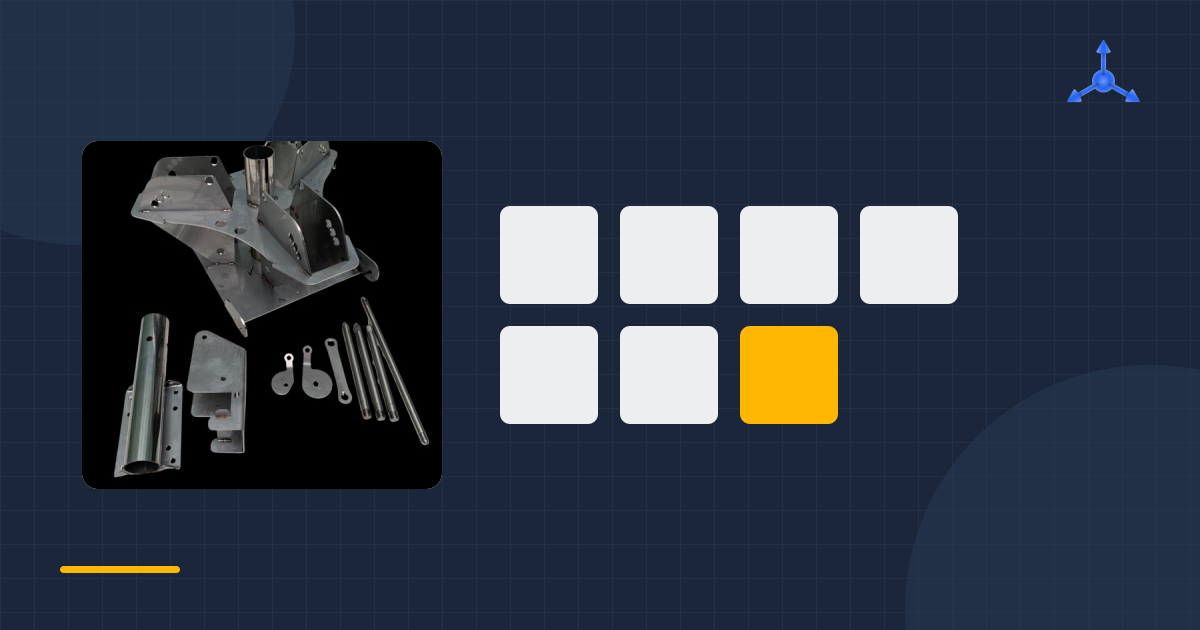
Custom fabricated assemblies are made by the partner factories Vector Components represents, not by Vector itself, and seven things decide whether the finished unit arrives usable. They are the drawing revision, the processes each part needs, which factory makes which part, the inspection stage, the transfer of parts between factories, the packaging, and the payment terms.
An original equipment manufacturer (OEM) ordering a single machined part has one supplier and one drawing. An assembly is different. Several parts, often several processes, sometimes several factories, and one unit that has to go together at the end.
If you are looking for a list of named fabrication suppliers to compare, that is a different page: Best Custom Sheet Metal Fabrication Suppliers for Industrial Equipment Makers names companies and quotes what each publishes about itself. This page is about what to settle once you have chosen.
- The drawing and its revision level.
- Which processes each part in the assembly needs.
- Which factory makes which part.
- The inspection stage, not just the inspection.
- How sub-parts move between factories.
- Packaging and labelling.
- Payment terms and the market you are buying into.
Who Makes the Part When the Drawing Is Yours?
The partner factories make it. Vector Components does not own or run a factory, and each factory in the network has an agreement authorizing Vector to serve as its overseas sales department.
That phrase is worth taking literally. A sales department quotes, takes the order, and answers for it. It does not own the plant, and it does not pretend the plant is something other than what it is.
The arrangement is why one party can quote an assembly whose parts come from more than one building. Vector is the authorized representative of several leading Chinese manufacturers of industrial components, serving customers in Canada and the United States.
Customer-designed parts are one of three kinds of work handled this way. The other two are standard parts batch-made to exact specifications, and off-the-shelf parts sourced as a courtesy.
An assembly built to your drawing is firmly the first kind. That matters for expectations: there is no catalogue page to point at, no stocked equivalent to fall back on, and nothing arrives until a drawing has been read by someone who will make it.
Computer numerical control (CNC) machining, casting, pipe fittings, flanges, ball valves, strut channel, sheet metal manufacturing and custom fabricated components are all listed capabilities. Which of them your assembly actually needs is the next question, and it is usually more than one.
Which Processes Does the Assembly Actually Need?
The main processes for customer-designed parts are CNC lathe, CNC mill, casting and wire electrical discharge machining (EDM). An assembly usually needs several, and that is what separates it from a single part.
Work from the parts list rather than the assembly drawing. Each line has a process behind it, and the processes do not all live in the same place.
A bracket may be sheet metal. A spindle may be turned on a lathe. A housing may be cast and then machined to final dimension on a mill.
That is three processes across one small assembly, three different sets of equipment, and a decision about where each one runs. A fourth appears as soon as a part is hardened before cutting, because then wire EDM does the work a mill cannot.
Mapping the list this way takes an hour and changes the quote. It also exposes the parts that nobody can place, which are the parts worth a conversation before the order rather than after it.
The alternative is to send the whole assembly to one factory and let it work out the rest. The next section is what that costs.
Why Does One Factory Per Part Beat One Factory for All?
Because a factory that cannot make a part usually subcontracts it and adds a commission. That raises the price, and it introduces quality and logistics problems the buyer never sees.
The subcontract is invisible from outside. A purchase order goes to one factory, parts come back, and nothing on the paperwork says that two of the five lines were made somewhere else.
Nor does anything say who made them. The subcontractor was chosen by a factory optimising its own margin on a line it did not want, which is a different objective from yours.
Vector selects the manufacturer for each part and process instead, and coordinates the transfer of parts between factories. The commission disappears because the subcontract does, and the factory for each part was chosen for the part.
Universal Sonar Mount is a worked example. It makes industrial and military-grade sonar mounting systems, and Vector supplies parts through its network alongside custom underwater cables and standard components.
Marine and submerged equipment is unforgiving about materials and finishes. A fastener or a housing that would pass in a dry indoor application fails in salt water, which makes the choice of factory per part a technical decision rather than a purchasing one.
Who Talks to the Production Engineer?
Vector's team works with the production engineers in their native language. Chinese engineers rarely speak English, and factory sales staff rarely have technical training.
On a single part that gap is survivable, because the drawing carries most of the intent. On an assembly it is where the intent gets lost.
The questions that decide an assembly are not on the drawing. How two parts locate against each other, which face is the datum, whether a tolerance is there for fit or for appearance: those get asked during production, and they get answered by whoever picks up the message.
Chinese factories also often trade under several names. Buying through Vector means the buyer knows who makes the part, which matters when one specific line in one specific assembly turns out to need that conversation.
Vector supervises inspection, assembly, packaging and shipping. The stage at which the inspection happens is the next item, and it is the one most often left unstated.
What Has to Be on the Order Before Production Starts?
All seven, in writing, before anything is cut.
The drawing and its revision. An order naming a drawing without a revision level is an order against whichever copy the factory holds. Put the revision on the purchase order, not in the covering email.
The process per part. Not as an instruction to the factory, but so that a part needing wire EDM is not quoted as a milled part and then quietly subcontracted when someone discovers it cannot be milled.
The factory per part. Ask which plant makes which line. The answer should be available, and an unavailable answer is itself useful information.
The inspection stage. A part checked after the unit is assembled is harder to replace than one checked as it leaves the factory that made it. On a cast part, check before the machining allowance is cut away, because a void under the surface is cheap to reject and expensive to discover later.
The transfer between factories. This is the step most quotes leave out, and the one that decides the schedule whenever a part has to travel before the unit can be built. Ask who arranges it and who carries the risk while it moves.
Packaging and labelling. An assembly that arrives correct and unlabelled still costs someone a day at goods-in. Specify how sub-assemblies are separated, bagged and marked.
Terms and market. Payment terms are NET 30. Canada is the first market and the United States second.
Send computer-aided design (CAD) drawings and specifications, and a quotation follows within one business day. Quotations are free, and the drawing stays yours.
Lead time on an assembly is quoted per order rather than published, because it depends on which processes the unit needs and the current load at each factory. A standard part made to a fixed specification is a different question with a different answer.
Send the drawing.
FAQs
Who actually makes a custom fabricated assembly ordered through Vector Components?
The partner factories Vector represents make the parts. Vector does not own or run a factory. Each factory in the network has an agreement authorizing Vector to act as its overseas sales department, which is why the buyer deals with one party while several factories may contribute parts to one assembly.
Why use more than one factory for a single assembly?
Because a factory that cannot make a part usually subcontracts it and adds a commission. That raises the price and introduces quality and logistics problems the buyer cannot see. Selecting the right factory for each part and process avoids the hidden subcontract, and coordinating the transfer between them becomes Vector's job rather than the buyer's.
What do you need to quote a custom fabricated assembly?
Drawings and specifications for every part in the unit, the revision level, and how the parts go together. A bill of materials helps. Send drawings and specifications and a quotation follows within one business day, at no cost. Incomplete drawings are the usual reason a quote takes longer.
At what stage are parts inspected?
Vector supervises inspection, assembly, packaging and shipping. On a multi-part assembly the stage matters more than the activity: a part checked after the unit is assembled is harder to replace than one checked when it leaves the factory that made it. Agree the stage before production starts.
How do you know which factory is really making the part?
Chinese factories often trade under several names, so the name on a quotation is not always the name on the floor. Each factory Vector represents has a written agreement, and Vector's team works with the production engineers in their own language rather than through a sales desk.
What are the payment terms?
NET 30. Canada is the first market and the United States the second. Lead time depends on the processes the assembly needs and the current load at each factory, which is why it is quoted per order rather than published as a standard figure.
Related Reading

Carl Erickson
Founder and Chief Executive, Vector Components
Carl Erickson is a mechanical engineer and the founder and chief executive of Vector Components. He first went to Shenzhen in 2005 and spent more than fifteen years there building electromechanical products, managing factories and developing supplier networks. Vector Components brings nearly two decades of hands-on manufacturing experience in China to its customers in Canada and the United States.
About Carl EricksonRelated Signals